

Table of Contents
Most of our clients come and ask us for a big, aesthetic showcase for their kitchens. At Marble Systems, we provide the highest quality natural stone options that look like sculpture. This week, we’ll look at monolithic islands. They are the kind of kitchen details nobody would just see and move on. You walk into the kitchen ,see it: a massive, solid cube of a natural stone. It doesn’t look like furniture. It looks like it was carved from a cliffside and dropped into the kitchen by a crane.

If you’re into modern kitchen designs with characteristic details, then a monolithic marble island is the true option for you. It rejects the skinny legs and open shelving of the past decade in favor of pure, heavy volume. But achieving this solid block look is a lot more complicated than just ordering a bigger piece of stone. If you are dreaming of a marble block kitchen island, but don’t want something that is too shabby and unintentional, you need to know exactly what you are asking for. Want to learn essential facts about monolithic islands? Here are the 5 essential facts about a monolithic kitchen island design, stripped of the sales talk.
1. It is Really Beautiful
Let’s spoil the magic trick right away. Unless you have a foundation built like a parking garage, you probably aren’t installing a solid 10,000 pound block of rock. The monolithic marble look is almost always a clever fabrication job.

Let me reveal our secret. We take standard natural stone slabs, usually 2cm or 3cm thick, and build a hollow box. The secret is the mitered edge island technique. By cutting the edges of the slabs at precise 45 degree angles and joining them, we create a sharp, seamless corner that mimics the geometry of a solid block. This gives you the visual gravity of a block marble island without crashing through your floor joists. Et voila! Most of our customers don’t know that, and when we tell them the correct way of installing a marble kitchen island, they feel surprised at how easy it can be!
2. Vein Matching is a Must and You Can’t Skip That
Think the opposite, what can happen if you don’t match the veins? Didn’t like the scene, right? You always have to match veins because you are essentially wrapping a box in stone, the pattern has to flow. If the grey vein on the top counter stops abruptly at the edge, the illusion is broken. It just looks like bad tiling on the marble countertops.
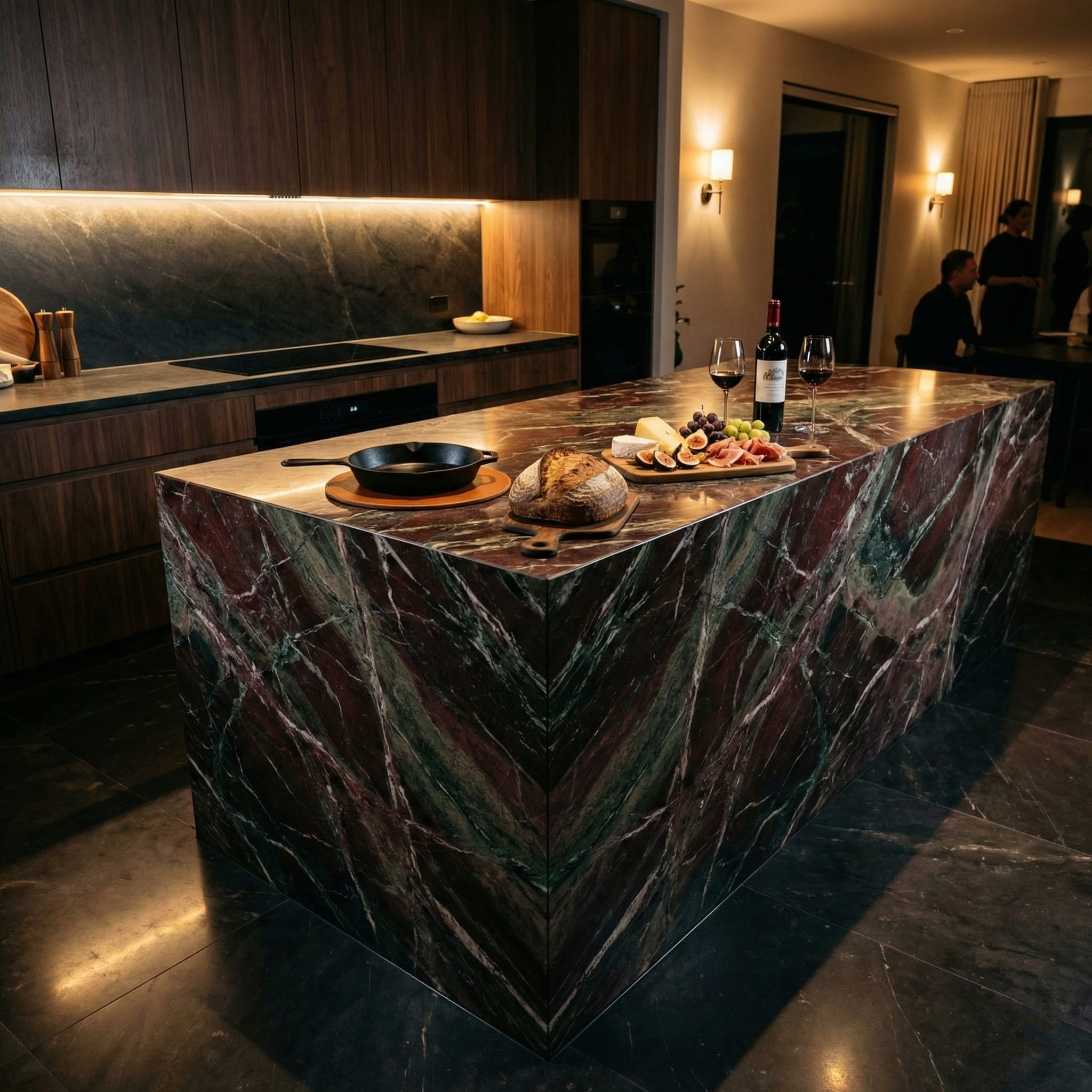
To get this right, you have to use bookmatched slabs. These are sequential slabs from the quarry that mirror each other, like an open book. No matter what if you are using a Calacatta Viola marble slab or classic white marble options, expert vein matching is the only way to make the transition from the horizontal marble kitchen countertop to the vertical sides look continuous. This is what separates a luxury installation from a DIY disaster. You have to make it right to make it look beautiful.
3. Structural Support is Vital and You Can’t Ignore It, Too

Just because it’s hollow doesn’t mean it’s light. A monolithic marble island involves vertical marble wall panels hanging off the side of your cabinets. You cannot just glue these to plywood and hope for the best. You need to discuss structural support for stone with your contractor before you even order the material. This often requires a custom steel subframe to hold the weight of the marble slab, especially if you want a floating seating area. You also need to check your subfloor. If you are laying this over marble tile flooring, the kitchen floor tile solutions underneath need to be rated for that kind of concentrated static load. Don’t skip the technical details, or the regrets will come back earlier than you think.
4. It Changes the Rules of Countertop Edge Profiles

In a normal kitchen, you worry about bullnose vs. eased edges. Here, the conversation is about the waterfall vs mitered edge. A standard waterfall island usually just drops the stone down the left and right sides. A monolithic design is more aggressive. It often wraps all visible sides, or creates T shapes and L shapes that feel like Tetris blocks made of stone. This requires a mitered edge island profile on every single corner to maintain that sharp block aesthetic. I know it sounds like too much and labor intensive, but things must be done in that way if you want that flowy look in the middle of your kitchen.
5. Be Aware of Fragile Corners
Here is the hard truth that Instagram doesn’t show you: those sharp, attractive corners are high risk zones. Because a monolithic marble island relies on that crisp mitered edge island profile to look like a solid block, you end up with a very sharp 90 degree angle of stone right where you work. Unlike a rounded bullnose edge that deflects impact, a mitered corner is brittle. If you swing a heavy cast iron skillet and clip the edge, you won’t just bruise your hip; you will likely chip the stone. So, if you want to avoid double trouble, you need to provide your security and double check it.

You also have to consider ergonomics. A true block marble island often goes straight to the floor without a recessed toe kick. This looks incredible, but it means you can’t stand close to the counter without stubbing your toes or leaning awkwardly. It is a major trade off between modern kitchen design aesthetics and actual comfort.
Shop Monolithic Marble Island with Marble Systems
Haven’t you decided yet? Is a monolithic marble island right for you? It’s okay if you haven’t decided yet, because you need to see what you will choose at first. Visit a Marble Systems showroom to explore our exclusive collection of natural stone slabs and see the difference for yourself. Touch our slabs and take a visual feast from beautiful marble slab colors and veining details in real life. Need more questions? Then call us and let us answer all of your questions right now!
Explore All Marble Countertops